Every M&E conference panel in the last two years has had at least one session on AI and report writing, and most of them land in one of two unhelpful places: breathless claims that AI will replace the evaluation report entirely, or blanket skepticism that treats any AI involvement in a findings document as inherently untrustworthy. Neither position survives contact with how these reports are actually produced. The honest answer is narrower and more useful than either extreme: AI is very good at a specific set of report-writing tasks, and genuinely dangerous at a different, equally specific set — and the difference between the two is whether the task requires generating structure from existing evidence, or inventing a claim the evidence doesn't contain.
Where AI genuinely helps
Drafting a narrative from an already-clean tabulation
This is the strongest use case, and it's strong precisely because it's constrained. Once a cross-tab or frequency table has been built and checked — sample sizes visible, outliers handled, significance considered where relevant — turning those numbers into readable prose is a mechanical translation task, not a judgment task. "62% of surveyed households in the intervention block reported using an improved cookstove, up from 34% at baseline (n=210)" is a sentence AI can generate reliably and quickly from a tabulated row, because every fact in that sentence already exists in structured form before the AI touches it. What used to take a report writer twenty minutes of translating a spreadsheet row into a paragraph — finding the right phrasing, checking the arithmetic on the percentage-point change, keeping the tone consistent with the rest of the document — becomes a near-instant first draft that a human then reviews rather than originates from scratch.
Restyling the same findings for different audiences
A program evaluation frequently needs to exist in more than one register: a donor wants a narrative that connects findings to impact and sustainability; a government department wants a format that matches its own reporting templates and emphasizes compliance and coverage; an academic partner wants methodology and limitations foregrounded. Manually rewriting the same underlying findings three or four times for three or four audiences is exactly the kind of repetitive, format-driven task AI handles well, because the substance isn't changing — only the register, emphasis, and structure are.
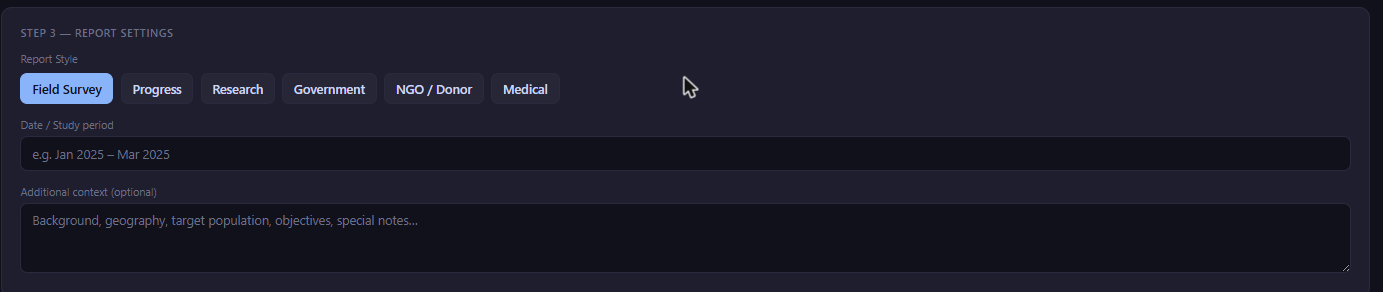
FG Writer's six report styles — Field Survey, Progress, Research, Government, NGO-Donor, and Medical — are built around exactly this pattern. The same cross-tab that produces a data-dense Research-style report can be restyled into a shorter, outcome-focused NGO-Donor report without a human rewriting every sentence from scratch, because the underlying numbers and their meaning don't change — only the framing, length, and section structure do. This is a genuine time saving that doesn't trade off against accuracy, because the source data being narrated is identical across styles.
Translating a report into a local language
India's field research and M&E ecosystem regularly needs the same report to exist in English and in one or more regional languages — Hindi, Kannada, Telugu, Marathi, and others, depending on the state and the audience. Manual translation of a twenty-page evaluation report is slow and, more importantly, is a task where a human translator without domain familiarity can introduce subtle errors in technical terms (confusing "prevalence" and "incidence," for instance). AI translation, reviewed by a bilingual team member familiar with the survey's terminology, gets a first-pass translation done in minutes rather than days, leaving the human reviewer to focus on terminology accuracy rather than starting from a blank page.
Catching inconsistent number references across a long document
This is an underrated use case. A thirty-page report drafted and revised over several weeks by multiple contributors routinely develops small internal inconsistencies — the executive summary says the sample was 1,840 households, the methodology section says 1,842, a chart caption says 1,850. None of these are large errors individually, but collectively they undermine a reviewer's confidence in the document's care. AI is well suited to scanning a full document and flagging every numeric claim, so a human can quickly check them against the source tabulation and reconcile the mismatches before publication — a task that's tedious and error-prone to do by eye across dozens of pages, and exactly the kind of pattern-matching AI does reliably.
Where AI should not be trusted unsupervised
Inventing causal claims the data doesn't support
This is the single most important failure mode to guard against, and it's a failure mode AI models are prone to specifically because they're optimized to produce fluent, confident-sounding prose. A model asked to "write up" a cross-tab showing a correlation between two variables will often reach for causal language — "led to," "resulted in," "drove improvements in" — because that phrasing reads more naturally and more persuasively than the more accurate, more hedged descriptive alternative. An unreviewed AI draft is genuinely more likely to smuggle in a causal claim than a careful human writer would, not less, because the model has no independent way to know whether the underlying survey design (cross-sectional versus panel, observational versus experimental) actually supports causal language — it only knows what reads well.
Generating statistics without a human checking significance or sample size first
An AI model asked to summarize "the difference between districts" from a dataset will readily compute and state a difference — a percentage-point gap, a rate comparison — without any built-in sense of whether that gap is meaningful given the underlying sample sizes. A seven-point gap between two subgroups of 40 respondents each is statistical noise; the same seven-point gap between two subgroups of 2,000 respondents each is a real, reportable finding. The AI model, left unsupervised, is equally happy to write a confident sentence about either one, because fluent prose generation and statistical judgment are different capabilities, and only the first is what a language model reliably does well.
Replacing field judgment about context that never shows up in a spreadsheet
The deepest limitation is structural, not a bug that better prompting fixes. A field supervisor who visited a village knows that the low latrine-usage numbers in one cluster are partly explained by a water-supply disruption that started two weeks before the survey round — a fact that never entered any form field, because nobody thought to add a question about it, and it wasn't the subject of the survey. AI, working only from the structured dataset, has no way to know this context exists, let alone weigh it. It will write a technically accurate summary of the numbers that is contextually incomplete, potentially misleading a reader into treating a temporary, explainable dip as a program failure. Only a human with field exposure — a supervisor, a coordinator, an enumerator who was actually there — can supply that layer, and no amount of AI capability substitutes for having asked the right person before the report goes out.
| Task | AI unsupervised | AI with human review |
|---|---|---|
| Drafting prose from a clean tabulation | Fast, generally reliable | Fast and safe — recommended default |
| Restyling for donor/government/academic audiences | Fast, generally reliable | Fast and safe — recommended default |
| Local-language translation | Usable first draft, terminology risk | Safe — bilingual reviewer checks terms |
| Cross-document number consistency check | Good at flagging, not deciding which is right | Safe — human resolves the discrepancy |
| Causal claims from cross-tabs | High risk of overstated language | Required — reviewer downgrades to descriptive framing where needed |
| Significance/sample-size judgment | High risk of treating noise as a finding | Required — reviewer checks n and variance first |
| Contextual field knowledge | Cannot supply what isn't in the data | Required — field staff input before the report is final |
The translation nuance most teams miss
It's worth dwelling a moment longer on local-language translation, because the risk profile there is different from the other AI-assisted tasks and easy to underestimate. Statistical and M&E terminology often doesn't have a single settled equivalent across Indian languages — "significant" in the statistical sense versus the everyday sense is a well-known translation trap in English itself, and the ambiguity doesn't disappear when the term is rendered into Hindi, Kannada, or Telugu. A term like "attrition rate" or "confidence interval" may get translated in a technically defensible but locally unfamiliar way, one a district-level reviewer fluent in the regional language but not in statistics would misread. This is exactly why the review step for translated reports needs a bilingual reviewer who also understands the survey methodology, not simply a fluent speaker checking for grammatical correctness. A grammatically perfect translation of a statistically wrong term is still a wrong report — fluency and accuracy are two different checks, and skipping the second because the first passed is a common, avoidable mistake.
A practical human-in-the-loop workflow
The workflow that captures the speed benefit without the risk is straightforward, and it maps closely to how a careful evaluation team should already be operating even without AI in the loop:
Step three is the one teams are most tempted to skip under deadline pressure, precisely because the AI draft reads so fluently that it feels already finished. That fluency is exactly why the check matters — a badly written sentence signals its own uncertainty, but a well-written AI sentence with an unsupported causal claim reads just as confidently as one that's fully backed by the data. The review step isn't optional polish; it's the entire safeguard that makes AI-assisted report writing trustworthy rather than merely fast.
Used this way — as a drafting and formatting accelerant sitting downstream of verified tabulation and upstream of expert and field review — AI genuinely compresses the time from clean data to a finished, multi-audience report, without asking anyone to trust a machine's judgment about what the data means. That's a meaningfully different claim than "AI writes your evaluation report," and it's the one that actually holds up under scrutiny from a donor board or a government reviewer.
Draft faster, without skipping the review
FG Writer drafts from your saved tabulations across six report styles — your team still reviews every numeric claim before it goes out.
Start Free Trial