There is a persistent myth in field research that data quality is primarily a cleaning problem — that you collect the data, then a cleaning pass or a clever detection algorithm catches whatever went wrong. Cleaning matters, and detection matters (we've written about both), but they are the second line of defense, not the first. The first line is training, and it does more to prevent bad data than every downstream check combined, because it stops the bad data from being generated in the first place rather than catching it after the fact.
The evidence for this is simple and recurring across field projects: the same three or four failure modes — rushed consent, poor probing on open-ended questions, sloppy GPS/photo capture, straight-lining under time pressure — show up survey after survey, project after project, regardless of how sophisticated the cleaning pipeline downstream is. These are not data-processing problems. They are training and supervision gaps that happen to surface as data quality issues weeks later.
What good enumerator onboarding actually includes
A one-hour orientation covering "how to use the app" is not enumerator training — it's device onboarding, and treating it as sufficient is one of the most common and costly shortcuts field projects take. Real onboarding covers the interview itself, not just the tool that records it.
Informed-consent delivery practice
Reading a consent script aloud correctly the first time, in a natural and unhurried way that a respondent actually understands, is a skill that needs rehearsal — it is not something most people do well cold. Enumerators should practice delivering the consent script out loud, in the local language, to a trainer or a peer playing the respondent, multiple times, with feedback on pacing and clarity, before they ever do it with a real respondent. This matters doubly under India's DPDP Act, where consent needs to be genuinely informed, not just technically recorded — a rushed, mumbled consent reading that a respondent didn't really absorb is a compliance risk as much as a data-quality one. (See our companion piece on DPDP-compliant field research for the legal detail; this article focuses on the operational side.)
Probing technique for open-ended questions
Open-ended questions ("What is the main challenge you face in accessing this service?") are where enumerator skill matters most and where training gaps show up most visibly in the data. An untrained enumerator accepts the first vague answer ("problems") and moves on; a trained one probes naturally ("Could you tell me a bit more about that?") without leading the respondent toward a particular answer. The difference between a dataset full of one-word non-answers and one with genuinely useful qualitative detail is almost entirely a training difference, not a respondent difference.
Device and app basics
This is the part most onboarding does cover, and it still deserves real practice time: navigating the form, understanding what "saved offline, not yet synced" looks like versus "synced," recovering from an accidental app close mid-form, and — critically — knowing not to panic and resubmit if a sync appears slow. A five-minute walkthrough is not enough; enumerators should complete several full practice submissions, including at least one deliberately interrupted (app closed, device restarted) so they've seen the app recover before it happens for real in the field.
GPS and photo capture standards
"Take a photo of the house" and "capture GPS" sound self-explanatory but produce wildly inconsistent results without a standard: photos taken from too far away to be useful, GPS captured from inside a vehicle en route rather than at the actual respondent location, photos of the wrong subject entirely. A short, specific standard — what to photograph, from what distance, when exactly to capture GPS (at the doorstep, not from the road) — removes most of this variation before it ever reaches a cleaning dashboard.
Ongoing QC during fieldwork, not just before it
Training reduces the rate of problems; it doesn't eliminate them, and even a well-trained enumerator has an off day, misunderstands one question, or works a village where GPS signal is genuinely poor. The second half of prevention is catching what training misses — quickly, while the field team is still in the area and can be corrected, rather than weeks later when the survey has closed and there's no way to go back.
Daily submission review by supervisors
A supervisor who reviews each enumerator's submissions at the end of every field day — even a quick fifteen-minute scan, not a full audit — catches problems while there's still time to fix them: a consistently blank GPS field, an unusually short average interview time, a pattern of skipped questions. Waiting for a weekly or end-of-survey review means the same mistake repeats for days or weeks before anyone notices.
Spot-checks
Beyond reviewing the data itself, supervisors accompanying enumerators for a portion of interviews — even briefly, even unannounced — catches things data alone never will: a consent script read too fast to be genuinely informed, a leading question, body language from a respondent that suggests discomfort the data wouldn't show. This is the same practice discussed in our fraud-detection guide, but its primary purpose here is developmental, not punitive — it's coaching, not auditing.
Real-time flagging so problems surface on day one
The single biggest lever for preventing systematic data-quality problems is shortening the gap between a mistake happening and someone noticing it. A form-logic error, a mistranslated question, or a misconfigured device setting that goes undetected for thirty days doesn't produce thirty days' worth of small, easily-fixed problems — it produces one large, expensive, often unfixable one. A supervisor dashboard that surfaces enumerator-level patterns in near real time turns "we found this in the post-survey cleaning pass" into "we caught this on day two."
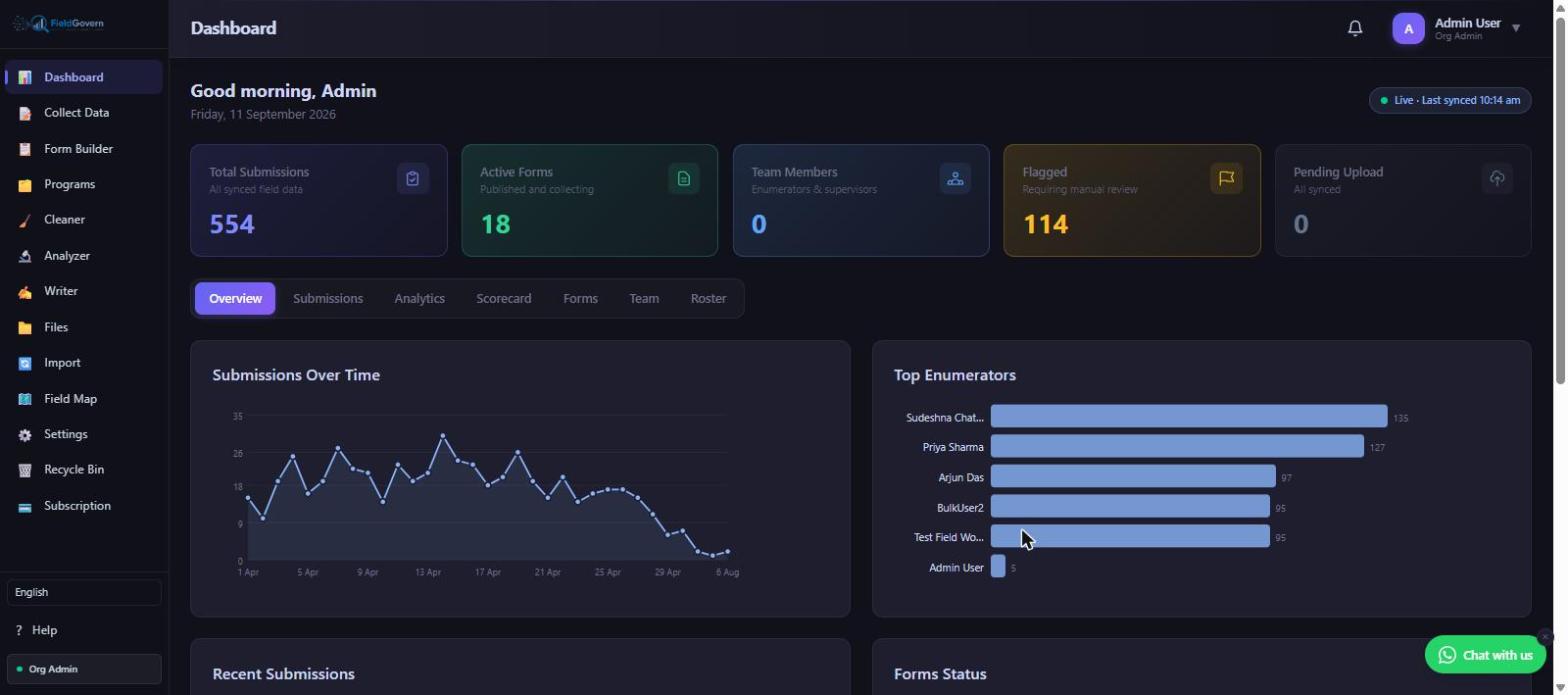
A leaderboard like this is useful for exactly the reason it sounds mundane: it turns "which enumerator needs a coaching conversation this week" from a guess into a visible pattern. An enumerator whose average completion time is a third of everyone else's, or whose flag rate is consistently double the team average, is worth a supervisor conversation on day three of fieldwork — not a footnote in the post-survey report.
Refresher training mid-survey, not just at the start
A single pre-fieldwork training session, however thorough, decays. An enumerator three weeks into a six-week survey has settled into habits — some of them shortcuts that crept in as fatigue and familiarity replaced the careful pace of week one. Straight-lining on matrix questions, in particular, tends to increase over the course of a long fieldwork period precisely because the questions start to feel repetitive to the person asking them, even though each respondent is hearing them for the first time. A short mid-survey refresher — thirty minutes, reviewing a handful of real (anonymized) examples of what's gone right and wrong so far — resets this drift far more effectively than hoping the original training holds for the full duration.
The content of a refresher should come directly from what the supervisor dashboard and daily reviews have actually surfaced, not a generic repeat of the initial training deck. If three enumerators have developed a habit of skipping the probe on one specific open-ended question, that's the one example worth walking through as a group, with the team discussing what a stronger probe would sound like. Specific, evidence-based feedback changes behavior; generic reminders mostly don't.
Measuring whether training actually worked
Training that isn't measured is training taken on faith. The practical way to check whether onboarding is doing its job is to compare data-quality indicators — average interview duration, flag rate, GPS-missing rate, probe depth on open-ended answers — between newly onboarded enumerators and the team's experienced baseline, in the first week of fieldwork specifically. A large, persistent gap in week one that doesn't close by week two is a signal that the training itself needs revision, not just that the individual enumerator needs more coaching. This is also the fastest way to know whether a change to the training program — a new consent-script rehearsal step, a revised device walkthrough — actually moved the needle, rather than assuming it did because it felt more thorough.
A pre-fieldwork training checklist
Before any enumerator is sent into the field independently, walk through this checklist. None of these steps are individually expensive, but skipping any one of them reliably shows up later as a data-quality problem that costs far more to fix after the fact.
The supervisor's role is different from the enumerator's
It's worth being explicit that field supervisors need their own training track, separate from enumerator onboarding, because the skills involved are genuinely different. An excellent enumerator promoted to supervisor without additional preparation often struggles with the shift from doing interviews well to reviewing other people's work objectively, giving feedback that changes behavior rather than just pointing out mistakes, and reading a dashboard for patterns rather than individual data points. Supervisor training should cover: how to give corrective feedback that a field team will actually act on rather than resent, how to interpret dashboard metrics like flag rate and average duration without over-reacting to normal day-to-day variation, and when a pattern is worth an intervention versus when it's noise from a small sample size. A team with well-trained enumerators and an under-trained supervisor still loses most of the benefit, because the supervisor is the layer that's supposed to catch and correct drift in real time.
Training is cheaper than cleaning, every time
A day of proper enumerator training, run once before fieldwork starts, costs a fraction of what it costs to discover — thirty days into a six-week survey — that a third of one enumerator's submissions are unusable because of a consent-delivery habit, a probing gap, or a device-setting mistake nobody caught early. The cleaning workflows and fraud-detection methods described elsewhere on this blog are essential, but they are damage control. Training, plus a supervisor dashboard that surfaces problems within days instead of weeks, is prevention — and prevention is always the cheaper half of the quality-control budget.
Give supervisors visibility from day one
FieldGovern's dashboard surfaces per-enumerator submission speed, flag rates, and quality trends in real time — so coaching happens during fieldwork, not after the report is due.
Start Free Trial