A randomised control trial (RCT) is not just a survey with a control group bolted on. It is a research design where the integrity of the randomisation, the fidelity of implementation, and the traceability of every data point back to its collection event are the whole point of the exercise — not nice-to-haves. Reviewers trained in the J-PAL/IPA tradition, journal referees, and pre-registration platforms will ask pointed questions about exactly these things. A data collection tool that works perfectly well for a routine monitoring survey can quietly fail an RCT, because routine M&E tolerates a level of informal process that RCTs cannot.
This article is a checklist of what to demand from a data collection tool before you commit it to a funded RCT — written for principal investigators, research managers, and M&E leads who are choosing a platform at the design stage, when switching later is expensive or impossible.
Why RCTs Have Stricter Data Requirements
In an RCT, the causal claim rests entirely on the comparison between randomly assigned groups staying valid from assignment through to analysis. Anything that threatens that comparison — a corrupted or re-assignable treatment list, an instrument that drifted between arms, imprecise fieldwork timing that lets non-compliance go undetected, or data that can't be independently re-analysed — threatens the core finding, not just a secondary indicator. This is why RCT protocols reviewed by institutional review boards (IRBs) and funders scrutinise the data collection plan in far more detail than a typical programme evaluation would receive.
What to Demand From a Data Collection Tool Before a Funded RCT
1. Tamper-Proof, Auditable Arm Assignment
Randomisation integrity is the single most scrutinised element of an RCT's data pipeline. Once a respondent is assigned to treatment or control, that assignment must be immutable in the field — an enumerator, supervisor, or well-meaning field coordinator should not be able to reassign a respondent's arm after the fact, whether by accident or to "fix" an inconvenient result. Your tool needs an explicit arm-assignment mechanism tied to a respondent key, logged with a timestamp and the identity of who triggered it, and visible in an audit trail that a co-PI or external auditor could review without touching the raw database.
FieldGovern's forms support an explicit assign-arm action tied to each respondent's unique key, recorded as a discrete, timestamped event rather than a free-text field an enumerator could edit. That distinction matters: a text field labelled "arm" can be overwritten by anyone with edit access; a logged assignment action creates a permanent record of when and how a respondent entered a given arm.
2. Blinding Considerations for Enumerators
Many RCT designs call for the enumerator collecting outcome data to be blind to a respondent's treatment status, to avoid interviewer bias contaminating the results — particularly for subjective or observer-rated outcomes. Ask whether your tool can hide the arm-assignment field from the enumerator's data collection interface entirely, showing it only to roles that need it (research coordinators, analysts) rather than baking it into every enumerator's screen. If your design calls for single-blind or double-blind data collection, this is a hard requirement, not a preference — a tool that displays "Treatment" or "Control" on the enumerator's tablet defeats the blinding by design.
3. A Version-Locked Instrument Across Arms
Every arm of your trial — treatment and control alike — must be surveyed with an identical instrument unless the design specifically calls for arm-differentiated questions (and even then, the shared outcome questions must be worded identically). The same version-control discipline that matters for baseline-endline studies matters doubly here: if your form gets edited mid-fieldwork and the edit reaches some enumerators before others, you have introduced a confound between arms that is very difficult to detect after the fact and nearly impossible to correct for statistically. Your tool needs a real version history — not just "the current form" — so you can confirm after the fact that every respondent, in every arm, was administered the same instrument.
4. Precise Timestamping for Compliance and Fidelity Monitoring
RCTs typically require fidelity monitoring — confirming the intervention and the data collection actually happened as designed, on schedule, without contamination between arms. This depends on accurate, tamper-resistant timestamps: when a household was visited, how long the interview took, whether a follow-up survey happened within the required window of a treatment event. A tool that lets timestamps be backdated, edited freely, or that only records a coarse "submitted on" date without a precise interview start/end time will make fidelity monitoring far harder to defend to funders and reviewers.
5. Exportable Raw Data for Independent Statistical Replication
Most RCT funders and increasingly most journals expect a replication package — the raw, de-identified data plus analysis code, available for an independent researcher to reproduce your results. This means your tool needs to export raw, unit-level data (not just aggregated summaries or dashboard charts) in formats your statistical team actually uses: Stata .dta, SPSS, or clean CSV with a documented codebook. If your data is trapped in a proprietary dashboard with no raw export, or the export strips variable labels and value codes that your Stata do-files depend on, you have a serious problem at the point of publication — usually discovered under deadline pressure, not in advance.
RCT Requirement Checklist for Tool Selection
| Requirement | Why It Matters | What to Ask the Vendor |
|---|---|---|
| Tamper-proof arm assignment | Protects randomisation integrity, the core of causal identification | "Is arm assignment a logged, timestamped action, or an editable field?" |
| Enumerator blinding | Prevents interviewer bias on subjective/observer-rated outcomes | "Can arm status be hidden from the data-entry role entirely?" |
| Version-locked instrument | Keeps treatment and control arms comparable | "Can I confirm, after fieldwork, that every respondent saw the identical form version?" |
| Precise timestamping | Supports fidelity/compliance monitoring against the trial protocol | "Are interview start/end times recorded automatically and immutable?" |
| Raw data export | Required for replication packages and independent re-analysis | "Can I export unit-level data as Stata .dta or SPSS with a full codebook?" |
Switching data collection tools mid-trial is close to impossible without threatening comparability between arms and waves. Every item on this list should be verified during vendor selection and, ideally, written into your pre-analysis plan or IRB protocol as a stated safeguard — not assumed.
Beyond the Core Five: What Else to Check
A few additional items worth confirming, particularly for multi-site or multi-arm designs:
- Offline reliability. Many RCT field sites — rural India especially — have unreliable connectivity. If enumerators can't complete interviews offline and sync later, you risk systematically losing data from your hardest-to-reach (and often most policy-relevant) respondents.
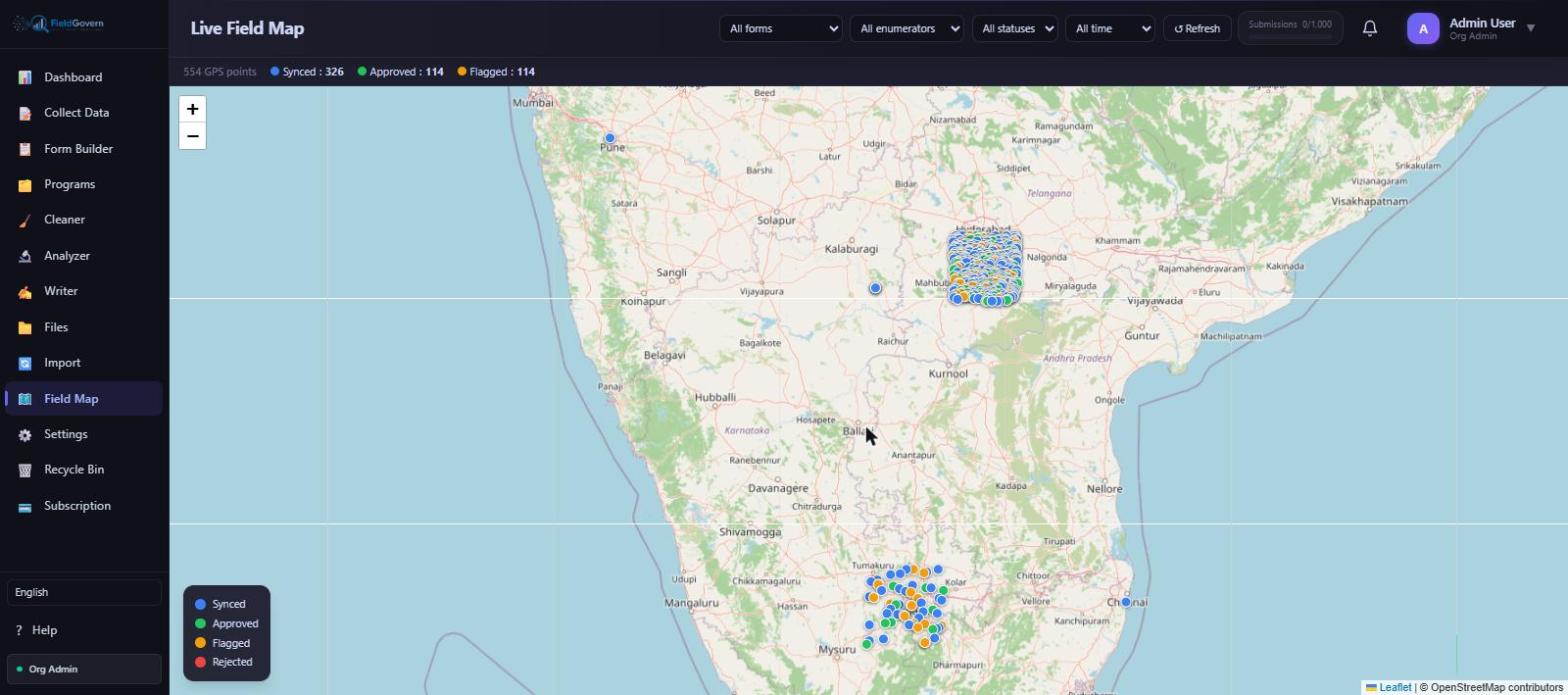
- GPS capture for location verification. Useful both for compliance monitoring (confirming visits happened where claimed) and for flagging potential contamination between geographically close treatment and control clusters.
- Duplicate and fraud detection. Fabricated or duplicated submissions are a real risk in large field teams under time pressure, and they bias results in ways that are hard to detect without systematic flagging built into the platform.
- Role-based access control. Enumerators, field supervisors, and the research/analysis team should have different levels of access — particularly to the arm-assignment data if blinding is part of the design.
What Happens When These Requirements Are Missing
The cost of skipping any item on this list rarely shows up during fieldwork — it shows up later, at exactly the moments where a study's credibility is most exposed.
Consider arm assignment first. If a tool stores treatment status as an ordinary editable field rather than a logged action, there is no way to prove, after the fact, that a control-arm respondent wasn't accidentally or deliberately moved to treatment mid-study — even if it never actually happened. A referee or replication team cannot distinguish "this never occurred" from "this occurred and left no trace," and in a peer-review process, that ambiguity alone is often enough to draw a critical revision request, regardless of whether tampering actually happened.
Instrument drift causes a quieter version of the same problem. If a question's wording or response scale changes partway through fieldwork and the tool has no version history, you may not discover the inconsistency until you're deep into analysis and the coefficients on a particular outcome look strange. Tracing the cause back to a mid-study form edit, after the fact, with imperfect institutional memory of who changed what and when, can cost weeks — and in the worst case, the inconsistency goes unnoticed and simply weakens your estimated effect size without anyone realising why.
Missing raw-data export is the most common failure of all, and the most avoidable. Teams that build their entire analysis workflow around a vendor's built-in dashboard frequently discover only at the replication-package stage — often under a journal's submission deadline — that the platform cannot produce a clean, labelled, unit-level extract in the format their statistical software expects. Reconstructing a usable dataset from a dashboard export or a series of screenshots is possible but slow, and it introduces exactly the kind of manual re-entry error this article's companion piece on indicator tracking warns against.
Data Monitoring and Interim Analysis
For trials with a Data and Safety Monitoring Board (DSMB) or an equivalent interim-analysis process, one more requirement belongs on this list: the ability to produce an interim extract that preserves blinding for anyone outside the monitoring committee. If your tool's export process routes through a single shared admin view with no way to restrict which roles can see arm assignment alongside outcome data, you risk breaking blinding for study staff who were never meant to see it, purely as a side effect of how the interim report was generated. Confirm this workflow explicitly if your trial design includes a monitoring board, rather than assuming role-based access will naturally extend to ad hoc interim exports.
A Pre-Commitment Checklist
None of this replaces good trial design — power calculations, a solid randomisation procedure, a pre-registered analysis plan. But a tool that can't support these five requirements will introduce exactly the kind of data integrity questions that RCT reviewers are trained to look for, at the exact moment — publication or funder audit — when you can least afford to discover them.
Built for Trial-Grade Data Integrity
Tamper-proof arm assignment, version-locked forms, automatic timestamping, and raw export to Stata and SPSS — FieldGovern supports the data requirements RCT reviewers actually ask about. Start a free trial or talk to us about your study design.
Start Free Trial